
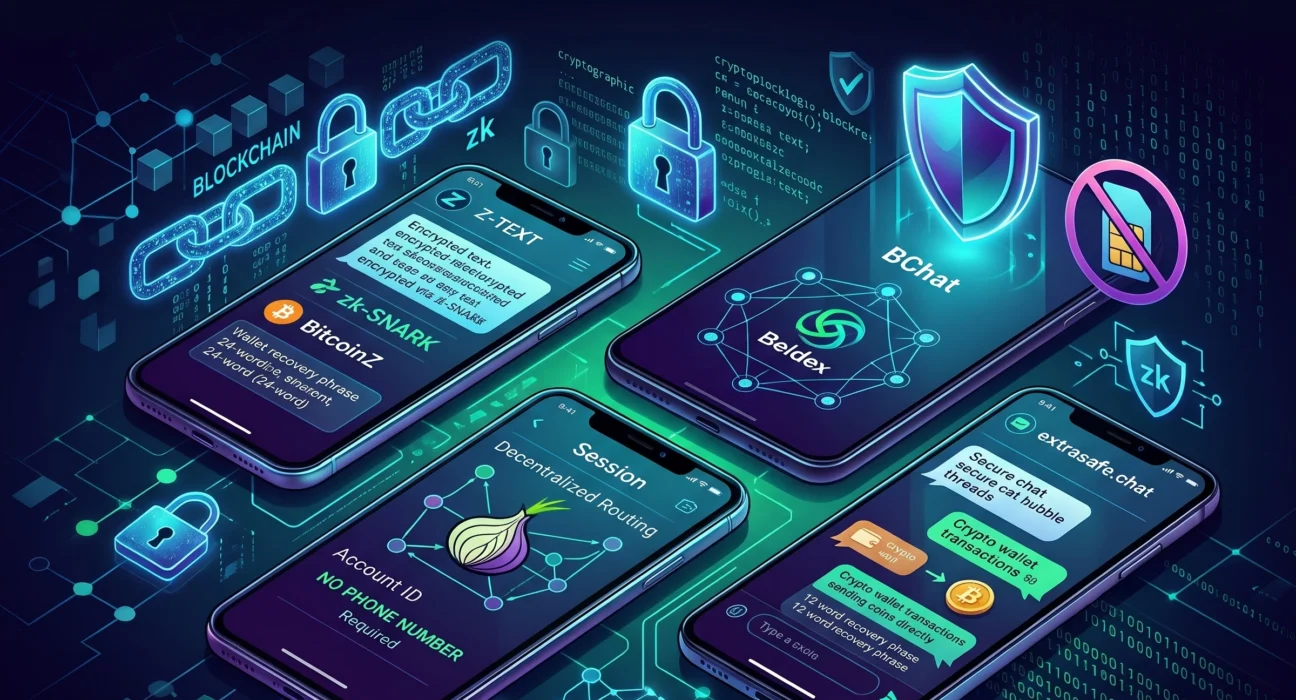
Most messaging apps ask for your phone number the moment you sign up. It’s convenient, but it also ties your chats to a number that says a lot about who you are. If you’d rather keep the two apart, you have more choices now than you did a few years ago.
Some of these apps run on blockchains. Others use decentralized networks, and a few tie your identity to a crypto wallet. But dropping the phone number doesn’t make an app private by default. What matters just as much is how it handles encryption, metadata, message storage, and account recovery. This article covers four options: Z-TEXT, Session, BChat, and extrasafe.chat.
Table of Contents
ToggleWhat Makes a Private Messenger Worth Using?
Encryption is the obvious starting point. End-to-end encryption means only the people in the conversation can read the messages. Even so, an app can still leak metadata, like when you sent something or what network connection you used.
Where messages are kept matters too. Some apps hold encrypted messages on servers for a while, and others use decentralized infrastructure or the blockchain itself. Recovery is the other thing people forget to check. With many of these apps, losing your recovery phrase or private key can mean losing the account for good.
1. Z-TEXT: Blockchain Messaging With Zero-Knowledge Technology
Z-TEXT is built on the BitcoinZ blockchain. It relies on shielded transactions and zk-SNARK technology to hide transaction details, including who sent a message and who received it.
You don’t need a phone number, an email address, or a SIM card to get started. Your identity is controlled by a 24-word wallet seed phrase instead.
Message content is encrypted with AES-256-GCM. Rather than sitting in a company’s central database, each message travels as a shielded transaction on the BitcoinZ blockchain and stays there permanently.
Z-TEXT is more than a messenger. The same app includes a BTCZ crypto wallet, a password manager, and Channels for on-chain broadcasting. One 24-word seed restores everything (messages, contacts, passwords, and wallet) on a new phone.
There are limits. Z-TEXT is text-only, with no calls or media, and the app is not open source yet. You also have to keep your 24-word phrase safe.
New users get one month free with 60 messages, and no payment card is needed. After that, Premium is a one-time payment, not a subscription.
Ideal for: permanent private messaging on the blockchain, plus a wallet and password manager in one app.
2. Session: Decentralized Messaging Without Phone Registration
Session is one of the better-known alternatives to Signal, and it doesn’t ask for a phone number or email at signup. You get an Account ID instead, which you share with your contacts.
Its main privacy tool is onion routing. Your messages pass through several nodes on a decentralized network, so no single node can easily see both the sender and the recipient. Everything is also end-to-end encrypted, and because Session is open source, developers and security researchers can inspect the code.
It covers the everyday basics: group chats, file sharing, disappearing messages, and voice and video calls. The trade-off is that decentralized routing can slow down delivery now and then, and you’ll need to keep your recovery information safe.
Ideal for: users who want decentralized messaging with onion routing and familiar features.
3. BChat: Private Communication Through the Beldex Network
BChat runs on the Beldex network and is meant for people who don’t want to sign up with a phone number or email.
Messages are end-to-end encrypted. According to its privacy information, they stay on users’ devices and may also be stored on servers in encrypted form for up to 14 days, so they can be delivered when the recipient is offline.
Network privacy needs a look as well. BChat’s documentation says that the first connection to a Beldex masternode can expose your IP address to that node, though the project says it isn’t recorded. Using a VPN can add another layer of protection. If decentralized messaging with a familiar interface appeals to you, BChat is a fair pick, but read its latest privacy policy before you sign up.
Ideal for: people interested in decentralized messaging and the Beldex ecosystem.
4. extrasafe.chat: Encrypted Messaging With a Crypto Wallet
extrasafe.chat brings private messaging and crypto self-custody into one app. Your identity is based on a wallet, so there’s no traditional account registration.
The platform says encryption keys are generated on your device and messages are encrypted before they’re sent. It offers encrypted chats, calls, file sharing, and voice notes.
The built-in wallet is what sets it apart. You can manage digital assets and send supported stablecoins right inside a chat, without switching apps.
Self-custody comes with responsibility, though. extrasafe.chat uses a 12-word recovery phrase to restore your chats and assets, and without it you may not be able to get your account back.
Ideal for: people who want encrypted messaging and crypto wallet features together.
Which Private Messenger Should You Choose?
Each app takes its own approach. If onion routing and decentralization matter most to you, look at Session. BChat is another decentralized option built on the Beldex network, and extrasafe.chat pairs messaging with a wallet.
Z-TEXT suits people who like the idea of blockchain-based messaging with shielded transactions. It also includes a BTCZ wallet, a password manager, and Channels, so it does more than send messages. The one-month free trial lets you try Z-TEXT before paying.
Whichever you pick, compare all four on encryption, metadata protection, storage, and account recovery. The best privacy blockchain messenger isn’t the one with the longest list of privacy claims. It’s the one whose strengths and limits you actually understand.
Final Thoughts
Messaging without a phone number helps keep your contact details separate from your online identity. Still, privacy goes well beyond how you sign up.
Z-TEXT, Session, BChat, and extrasafe.chat each handle private communication differently. Look at how they encrypt, where they store messages, what extras they offer, and how you recover your account, then choose the one that fits what you expect from a private messenger.