
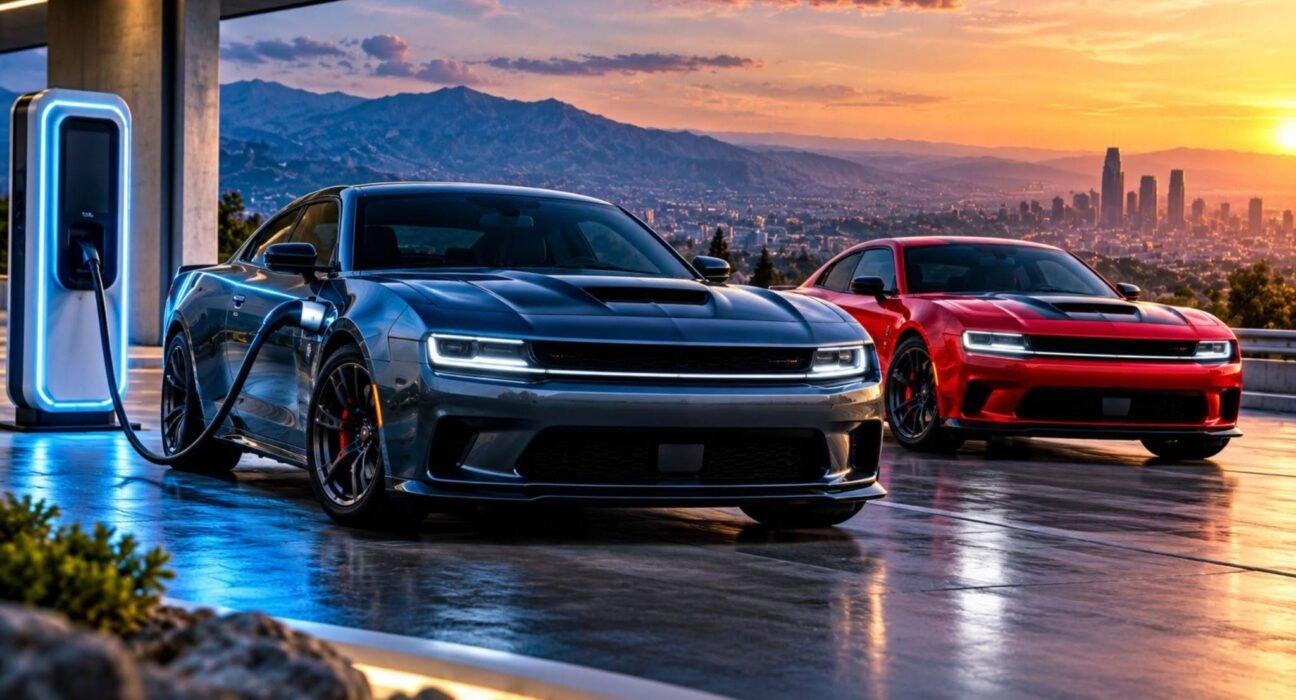
The 2025 Dodge Charger Daytona combines electric performance with the bold character of a modern muscle car. Its dual-motor powertrain delivers strong acceleration, while its large battery is designed to provide enough driving range for daily commutes and longer journeys. However, the distance you can travel between charges depends on which version you choose, how you drive, and the charging facilities available along your route.
If you are considering this electric Dodge, understanding its range, battery capacity, home charging options, and DC fast-charging performance can help you decide whether it fits your lifestyle. This guide explains what to expect from the Charger Daytona R/T and Scat Pack, how long charging takes, and which factors can affect real-world efficiency.
Table of Contents
Toggle2025 Dodge Charger Daytona Range: How Far Can It Travel?
The 2025 Dodge Charger Daytona is available in two main electric versions: the R/T and the Scat Pack. Both use a 100.5-kWh battery pack, but their driving ranges differ because their performance configurations and energy consumption are not identical.
Dodge’s published specifications have included an estimated range of up to 317 miles for the R/T and 260 miles for the Scat Pack. Other published specification documents list different figures, including 308 miles and 241 miles, respectively. These differences make it important to check the official specifications for the exact model and configuration you are considering.
Specification | Charger Daytona R/T | Charger Daytona Scat Pack |
Battery capacity | 100.5 kWh | 100.5 kWh |
Usable battery energy | 93.9 kWh | 93.9 kWh |
Published range figures | Up to 317 miles in initial estimates; other specifications list 308 miles | Up to 260 miles in initial estimates; other specifications list 241 miles |
Onboard AC charger | 11 kW | 11 kW |
Peak DC charging rate | Up to 183 kW | Up to 183 kW |
Drivetrain | Dual-motor AWD | Dual-motor AWD |
Specifications are drawn from Dodge’s published 2025 Charger Daytona documentation. Range figures vary between published documents and configurations, so confirm the applicable EPA rating for the specific vehicle. For the manufacturer’s published specifications, battery details, and estimated range, consult the official 2025 Dodge Charger Daytona buyer’s guide.
The R/T is the more range-focused choice of the two. Its lower performance output can help it travel farther on a full charge under comparable conditions. The Scat Pack prioritizes stronger acceleration, which can come with a range trade-off.
For drivers who regularly travel long distances, the R/T may be the more practical option. Buyers who value maximum performance may find the Scat Pack’s shorter estimated range an acceptable compromise.
2025 Dodge Charger Daytona R/T Range vs. Scat Pack Range
Choosing between the two trims involves more than comparing horsepower. Your daily mileage, access to charging, and driving habits should also influence the decision.
Charger Daytona R/T range
The R/T is designed to balance electric performance with everyday usability. Its published range estimates make it the more suitable version for drivers who want to reduce charging stops on longer journeys.
For example, someone with a predictable daily commute may be able to cover several days of driving before recharging, depending on distance and energy consumption. Drivers who frequently travel between cities should still plan their routes around suitable charging stations rather than relying entirely on the maximum advertised range.
Charger Daytona Scat Pack range
The Scat Pack delivers considerably more power, but its performance-focused setup can reduce the distance available from a full battery. Its published range estimates are lower than those of the R/T.
Frequent hard acceleration and high-speed driving can further increase energy consumption. That does not make the Scat Pack unsuitable for everyday use, but buyers should consider whether its additional performance is worth the potential reduction in driving range.
Range is only one factor when comparing the two trims. To learn more about their power output, torque, and acceleration, read our detailed guide to Charger Daytona horsepower and performance.
Dodge Charger Daytona Real-World Range: What Affects It?
An advertised range figure is a useful starting point, but it is not a guarantee of how far every driver will travel. Real-world results depend on several conditions.
Driving speed: Highway driving at sustained high speeds generally consumes more energy than moderate-speed driving. Aerodynamic resistance increases as speed rises, which can reduce the distance covered per charge.
Temperature: Cold weather can reduce battery efficiency and increase the energy needed to heat the cabin. Very hot conditions can also affect energy consumption, particularly when climate control is running frequently.
Acceleration and driving style: Rapid acceleration, repeated high-power driving, and aggressive driving modes can increase electricity use. Smooth acceleration and anticipating traffic can help improve efficiency.
Wheels and tires: Different wheel and tire configurations can affect rolling resistance and overall efficiency. Optional performance-oriented tires may not deliver the same efficiency as other configurations.
Passenger and cargo load: Carrying additional weight can increase energy consumption, particularly during repeated acceleration and changes in elevation.
These factors explain why two Charger Daytona owners can report different distances on a full battery. For a realistic estimate, use the vehicle’s displayed efficiency and recent driving history rather than assuming that the maximum published figure will always be achievable.
2025 Dodge Charger Daytona Battery: Capacity and Practical Use
Both the R/T and Scat Pack use a 100.5-kWh high-voltage lithium-ion battery. The published usable energy capacity is 93.9 kWh, which is the portion of the battery’s energy available for normal driving.
The difference between total and usable capacity is common in electric vehicles. Battery management systems reserve some energy to support battery operation and help protect long-term performance.
Battery capacity alone does not determine range. A vehicle’s efficiency also matters: two electric cars with similar battery sizes can travel different distances depending on weight, aerodynamics, tires, powertrain design, and driving conditions.
For owners, the most useful habit is to monitor energy consumption over time. After several weeks of commuting and highway driving, the vehicle’s own data can provide a better estimate of typical range for your routine.
How Long Does a Dodge Charger Daytona Take to Charge?
Charging time depends on the power source, the battery’s current charge level, and the vehicle’s charging limits. The Charger Daytona supports Level 2 AC charging at up to 11 kW and DC fast charging at a peak rate of up to 183 kW.
The following published charging estimates help illustrate the difference between home charging and public fast charging.
Charging method | Approximate charging time |
Level 2 AC at 11 kW, 5% to 80% | 6.8 hours |
Level 2 AC at 11 kW, 20% to 80% | 5.4 hours |
DC fast charging using a 175-kW station, 5% to 80% | 52.4 minutes |
DC fast charging using a 175-kW station, 20% to 80% | 41.9 minutes |
DC fast charging using a 350-kW station, 5% to 80% | 32.5 minutes |
DC fast charging using a 350-kW station, 20% to 80% | 24 minutes |
These are published specification estimates, not guaranteed charging times. Actual results depend on battery temperature, starting charge, charging-station performance, and other conditions.
Although the vehicle can connect to a 350-kW DC fast charger, it does not continuously draw 350 kW. Its published peak charging rate is approximately 183 kW, and charging power changes as the battery fills.
This distinction matters when planning road trips. A higher-rated charging station does not automatically mean the vehicle will charge at that station’s maximum advertised power.
Dodge Charger Daytona Home Charging Time
Home charging can be convenient for drivers who have access to a suitable parking space and electrical installation. Instead of visiting a public station regularly, owners can recharge while the car is parked overnight.
The Charger Daytona’s 11-kW onboard charger supports Level 2 AC charging. With a compatible home charging unit and an adequate electrical supply, a substantial recharge can take place over several hours.
For many drivers, charging at home is less about filling the battery from empty and more about replacing the energy used during the day. If your commute consumes only a portion of the battery, an overnight charging session may be enough to restore that energy before the next trip.
Installation requirements should be checked before buying a home charger. A qualified electrician can assess the home’s electrical capacity, circuit requirements, and the appropriate charger for the vehicle. Charging times may be longer if the installation delivers less power than the vehicle’s maximum AC charging capability.
Owners should also check their electricity rates and any time-of-use plans offered by their utility. Charging during lower-cost periods, where available, may help reduce running costs.
Dodge Charger Daytona DC Fast Charging Time
DC fast charging is more useful when you need to continue a journey without waiting several hours. It supplies direct current to the vehicle’s battery system, bypassing the onboard AC charging conversion process used during home charging.
With a suitable 350-kW charging station, published specifications indicate that the Charger Daytona can charge from 20% to 80% in approximately 24 minutes under favorable conditions. A 175-kW station takes longer according to Dodge’s published estimates.
However, several practical factors can affect a charging stop. The station may not deliver its advertised maximum output, other vehicles may share its available power, and a cold or nearly full battery may accept energy more slowly.
Charging also tends to slow as the battery approaches a high state of charge. During a road trip, it can therefore be more efficient to stop for a useful partial recharge than to wait for the battery to reach 100% at every stop.
Before a long journey, check the location, connector compatibility, availability, and operating status of charging stations along your route. This is especially important in areas where high-power charging networks are limited.
What Charger Does the Dodge Charger Daytona Use?
The answer depends on whether you are charging at home or using a public station. Level 2 home charging uses an AC connection, while DC fast charging requires a compatible public fast-charging connector.
The 2025 model’s charging-port and connector requirements should be verified against the exact vehicle and market specification before purchasing equipment or planning a trip. Connector standards and network compatibility can differ by region and model year.
When selecting a public charger, check the connector type and the station’s supported charging power. A station with a high power rating is useful only if the vehicle can connect to it and the station can supply the appropriate output.
For home use, choose a charging unit compatible with the vehicle and have it installed according to local electrical codes. This helps ensure safe and dependable charging.
Tips for Getting More Range From Your Charger Daytona
A few practical habits can help you get more distance from each charge.
Maintain a steady speed whenever traffic conditions allow, and avoid unnecessary rapid acceleration. Use the vehicle’s available regenerative braking settings appropriately to recover some energy during deceleration. Regenerative braking does not replace energy already consumed, but it can help improve efficiency in suitable driving conditions.
Use climate control sensibly, especially in extreme temperatures. If your vehicle supports scheduled charging or cabin preconditioning while plugged in, these features may help manage energy use before departure.
Keep tires properly inflated according to the manufacturer’s recommendations, remove unnecessary cargo, and use the vehicle’s energy-consumption display to identify patterns. If your range drops noticeably, consider whether weather, driving speed, tire pressure, or recent route changes could explain the difference.
Most importantly, plan long journeys using a conservative range estimate. Leaving a reasonable battery reserve is more practical than depending on the highest advertised range figure.
Is the 2025 Dodge Charger Daytona Practical for Long Trips?
The Charger Daytona can be suitable for longer journeys when the route has compatible fast-charging stations and the driver plans charging stops in advance. Its ability to use DC fast charging makes it more flexible than an electric vehicle that relies only on slower AC charging.
Still, long-distance convenience depends heavily on the charging network. Drivers who regularly travel through areas with reliable fast chargers may find trip planning straightforward. Those who drive through regions with limited infrastructure should check station locations and have backup options.
The R/T’s higher published range estimates may appeal to frequent travelers, while the Scat Pack is better suited to buyers who prioritize performance and are comfortable with potentially more frequent charging stops.
Your typical driving distance, home charging access, and local electricity costs are just as important as the vehicle’s official range rating.
For a broader look at the car’s power, features, and specifications, read our complete 2025 Dodge Charger Daytona guide.
Frequently Asked Questions
How far can a 2025 Dodge Charger Daytona go on one charge?
Published range figures differ across Dodge documents and configurations. Initial estimates cited up to 317 miles for the R/T and 260 miles for the Scat Pack, while other specifications list 308 miles and 241 miles. Check the exact vehicle’s official rating, and remember that real-world range varies with driving conditions.
How long does a Dodge Charger Daytona take to charge at home?
With an 11-kW Level 2 AC charger, published estimates are approximately 6.8 hours for a 5% to 80% charge and 5.4 hours for a 20% to 80% charge. Actual times depend on the electrical supply and charging conditions.
How fast can the Charger Daytona charge at a DC fast charger?
With a compatible 350-kW station, published specifications estimate approximately 24 minutes for a 20% to 80% charge. The vehicle’s peak charging rate is around 183 kW, so it will not continuously draw the station’s full 350-kW rating.
Does the R/T have more range than the Scat Pack?
Published estimates generally give the R/T a longer range than the Scat Pack. The R/T focuses more on balancing performance and efficiency, while the Scat Pack prioritizes higher output and acceleration.
What is the battery capacity of the 2025 Dodge Charger Daytona?
Both the R/T and Scat Pack use a 100.5-kWh battery pack, with published usable energy of 93.9 kWh.
Can I charge the Charger Daytona every night?
Yes. Regular home charging can be convenient if you have a suitable installation. Follow the vehicle manufacturer’s charging guidance and use compatible equipment installed according to local electrical requirements.
Final Thoughts
The 2025 Dodge Charger Daytona combines a large battery, dual-motor all-wheel drive, and fast-charging capability in an electric muscle car. The R/T is generally the more range-focused choice, while the Scat Pack delivers stronger performance with a lower published range.
For everyday ownership, the key questions are how far you typically drive, whether home charging is available, and how easy it is to find compatible fast chargers on your regular routes. Understanding these factors will give you a more realistic picture of what living with the Charger Daytona could be like.