
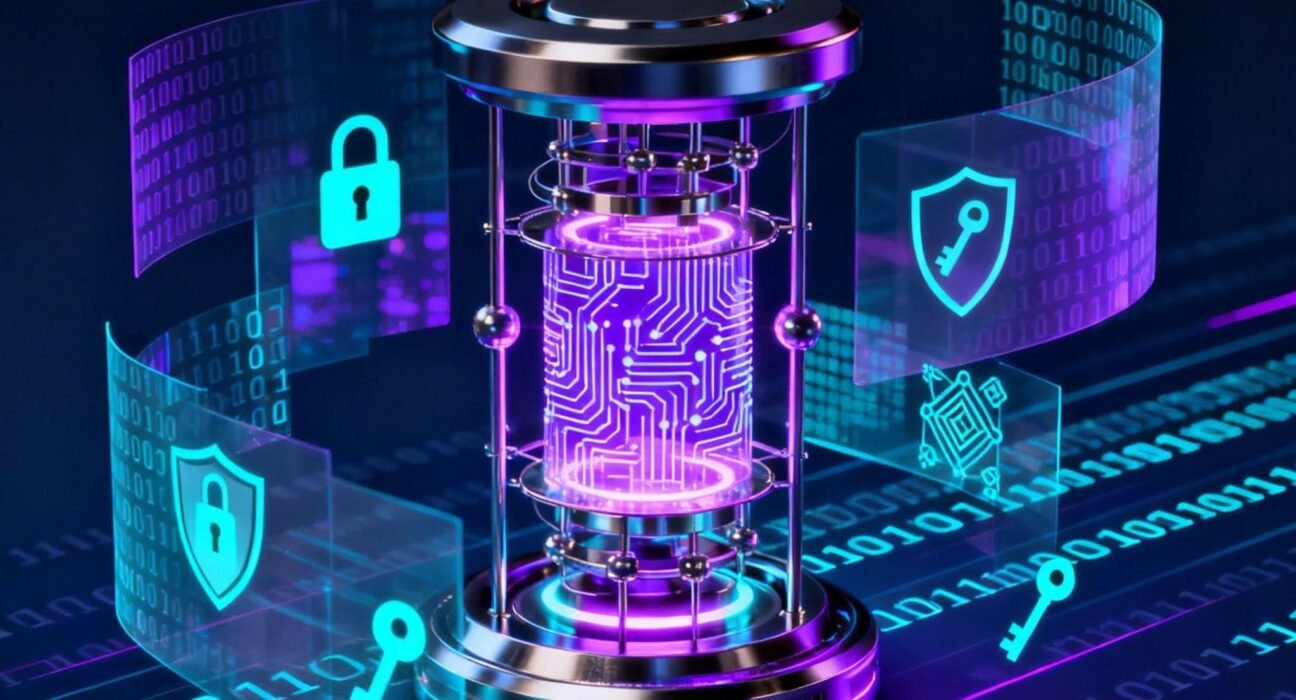
Quantum computing cybersecurity starts with understanding how quantum computers differ from classical systems. Quantum computers use qubits instead of bits. Unlike classical bits, which represent either 0 or 1, qubits can exist in multiple states simultaneously thanks to superposition, entanglement, and interference. This allows quantum systems to process data exponentially faster than classical computers for specific tasks. As this field evolves, it aligns closely with broader developments covered in trends and innovations in information technology.
Table of Contents
ToggleWhy Cybersecurity is Critical
While this computational power promises breakthroughs in medicine, finance, and material science, it simultaneously threatens existing encryption standards. Today’s security protocols, such as RSA and elliptic curve cryptography (ECC), rely on problems that classical computers cannot solve efficiently. Quantum computers, however, can exploit algorithms such as Shor’s to break these protocols, exposing sensitive enterprise data. Businesses already focused on digital protection may also find value in practical security measures like those discussed in best antivirus software.
The Quantum Threat to Encryption
How Quantum Breaks Classical Security
Encryption systems today rely on large prime number multiplication and elliptic curve mathematics. These methods are computationally secure against classical computers but vulnerable to quantum attacks. A sufficiently advanced quantum computer could factor large numbers in hours, rendering current encryption obsolete.
Harvest Now, Decrypt Later
One major concern is the “harvest now, decrypt later” strategy. Data captured today could be stored by attackers and decrypted years later once quantum computing reaches sufficient power. Sensitive enterprise data—financial transactions, legal records, and intellectual property—would be at risk, making quantum computing cybersecurity a strategic imperative.
Post-Quantum Cryptography: A New Defense
What is Post-Quantum Cryptography
Post-quantum cryptography (PQC) involves algorithms designed to resist quantum attacks. Unlike classical cryptography, PQC relies on mathematical problems that remain hard even for quantum systems. Lattice-based schemes, like CRYSTALS-Kyber and CRYSTALS-Dilithium, are examples of emerging standards recommended by the National Institute of Standards and Technology (NIST). Readers interested in how next-generation systems reshape the digital world may also like blockchain technology reshaping the digital future.
Implementing PQC in Enterprises
Transitioning to PQC requires auditing current encryption systems, prioritizing critical data, and testing quantum-resistant protocols. Legacy systems may need extensive updates, and global interoperability can be challenging. Companies must also educate stakeholders and develop long-term roadmaps for secure migration. For organizations planning that transition, both CISA’s quantum-readiness migration guidance and the NIST NCCoE migration to PQC project offer useful starting points.
Quantum Key Distribution: The Future of Secure Communication
How QKD Works
Quantum key distribution (QKD) is a quantum-based method for secure communication. It uses photons to transmit encryption keys, and any eavesdropping attempt disturbs their quantum state, alerting both sender and receiver. This makes QKD theoretically immune to interception.
Early Implementation and Challenges
Countries like China have demonstrated QKD using satellites and fiber networks over long distances. While effective, the technology is currently expensive and infrastructure-intensive, making widespread adoption challenging. However, pilot programs in sensitive industries like finance and healthcare can help organizations prepare for practical deployment.
Enhancing Qubit Performance
The Importance of Coherence Time
Qubits can exist in superposition, allowing quantum computers to process complex computations rapidly. However, qubits are extremely sensitive to environmental noise, leading to qubit decoherence and loss of information. Longer coherence times allow more computations before errors occur, improving overall reliability.
Recent Advances in Qubit Stability
Researchers have achieved record coherence times of over one millisecond in transmon qubits. Although brief by human standards, this allows millions of operations at nanosecond speeds. Optimized wiring, clean circuit interfaces, and careful material selection all contributed to this breakthrough, reducing reliance on error correction and making practical quantum computing more feasible.
The Role of AI in Quantum Computing Cybersecurity
AI-Driven Hardware Optimization
Artificial intelligence is crucial for designing and operating quantum computers. AI can optimize qubit geometries, propose experimental setups, and generate efficient quantum circuits. Work in this area is reflected by Google Quantum AI, which focuses on advancing large-scale quantum systems and supporting tools. This topic also connects naturally with governance and implementation questions explored in AI governance for small business.
AI in Device Characterization
AI also reconstructs Hamiltonians or Lindbladians to model quantum systems. By learning noise patterns and environmental drift, AI can improve qubit stability, extend coherence times, and reduce operational errors. Automated calibration reduces the need for manual tuning, enhancing quantum computing cybersecurity.
Quantum Machine Learning: Opportunities and Challenges
Quantum ML in Data Protection
Quantum machine learning (QML) combines quantum computing and classical ML to tackle complex, high-dimensional problems. Algorithms such as variational quantum circuits and quantum kernel methods allow faster optimization, clustering, and anomaly detection, enhancing cybersecurity measures.
Current Limitations
Despite its potential, QML faces challenges. Hardware is still developing, and error rates are high. Classical simulation of QML is resource-intensive, while quantum annealing provides an alternative for optimization problems. Quantum-inspired algorithms allow classical computers to mimic quantum techniques for early-stage implementation, offering partial benefits until large-scale hardware matures.
Preparing Enterprises for a Quantum Future
Immediate Steps for Organizations
Enterprises must begin auditing encryption systems, transitioning to PQC, and prioritizing critical data. Tracking NIST standards and conducting pilot programs for QKD and quantum-enhanced security tools helps organizations stay ahead of the quantum threat. Businesses modernizing their operations may also benefit from related infrastructure planning discussed in cloud technology for small business.
Long-Term Planning
Beyond immediate steps, companies should invest in quantum cybersecurity expertise, collaborate with academic and industry partners, and develop a long-term roadmap for integrating quantum computing technologies. This includes preparing infrastructure for hybrid quantum-classical systems and planning for future AI-assisted quantum operations.
Strategic Implications
Quantum Computing as a Double-Edged Sword
Quantum computing cybersecurity represents both a threat and an opportunity. It challenges current encryption methods while offering tools, such as QKD and QML-based anomaly detection, to strengthen enterprise security. Proactive planning can prevent catastrophic breaches and position companies to benefit from quantum technology.
Why Acting Now is Crucial
The timeline for capable quantum computers is uncertain, with estimates ranging from ten to twenty years. Delaying preparation risks exposing critical enterprise data to future quantum attacks. Early adoption of PQC, AI-assisted quantum operations, and pilot QKD programs ensures that enterprises are ready to protect sensitive information while leveraging quantum computing for competitive advantage. For a broader view of where innovation is headed, readers can explore technology innovation in industry and the future beyond smartphones.
Quantum computing cybersecurity is no longer a distant concern; it is a strategic priority. By understanding quantum threats, implementing post-quantum defenses, leveraging AI, and preparing for hybrid quantum-classical systems, enterprises can secure sensitive data and capitalize on the opportunities this revolutionary technology offers.