
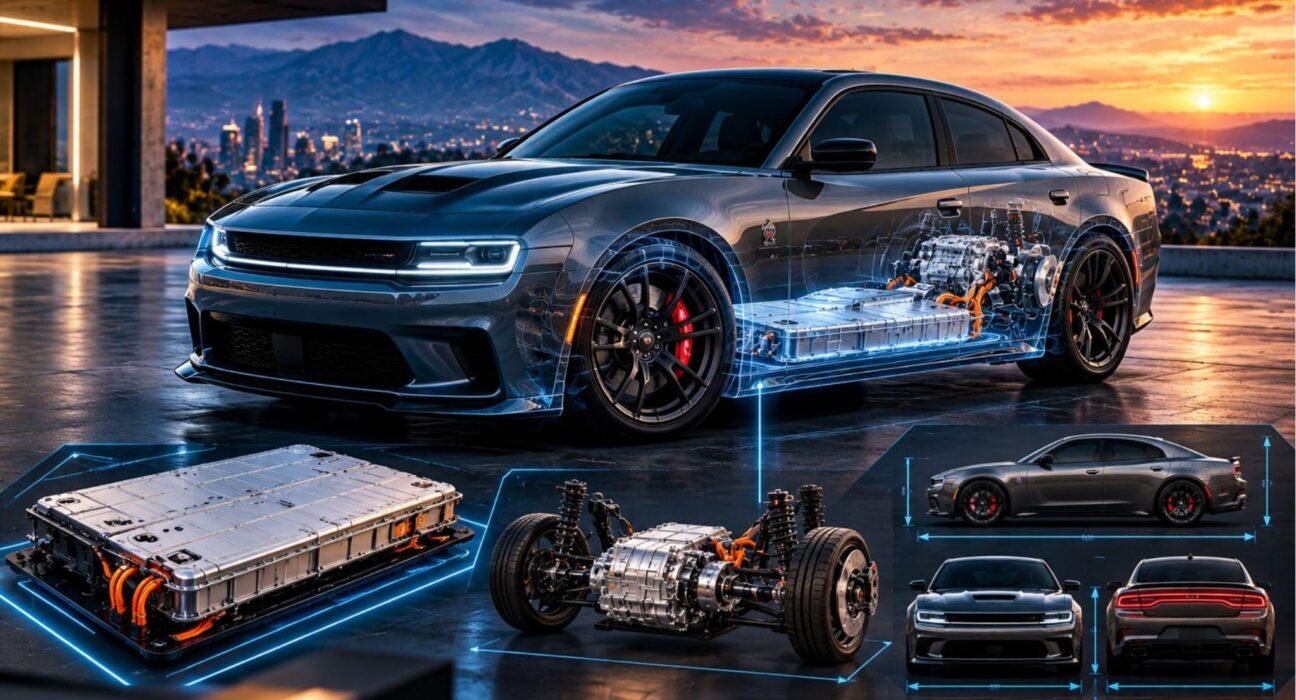
The 2025 Dodge Charger Daytona brings electric power to the American muscle-car formula. Instead of a traditional gasoline engine, it uses two electric drive motors, a high-voltage battery pack, and standard all-wheel drive. Its technical specifications also vary by trim, so understanding the differences between the R/T and Scat Pack can help buyers decide which version better suits their needs.
This guide covers the 2025 Dodge Charger Daytona specs, including battery capacity, exterior dimensions, drivetrain configuration, motor output, and key mechanical features.
Table of Contents
Toggle2025 Dodge Charger Daytona Specifications at a Glance
The Charger Daytona combines a 400-volt electrical system with front and rear electric motors. Both the R/T and Scat Pack use an all-wheel-drive configuration, but their power outputs and performance equipment differ.
Specification | 2025 Dodge Charger Daytona |
Vehicle type | Battery-electric muscle car |
Body style | Two-door coupe with rear hatch |
Electrical architecture | 400 volts |
Battery capacity | 100.5 kWh gross; approximately 93.9 kWh usable |
Electric motors | Two, front and rear |
Drivetrain | Standard all-wheel drive (AWD) |
Onboard AC charger | 11 kW |
Transmission | Single-speed reduction gearing |
Wheelbase | 121 inches |
Overall length | 206.6 inches |
Width without mirrors | 79.8 inches |
Height | Approximately 59 inches |
Seating capacity | Five |
Specifications can vary with trim, wheels, tires, and equipment. Battery figures refer to the pack’s advertised total capacity and usable energy, respectively.
Battery Capacity and Electric Powertrain
The 2025 Dodge Charger Daytona uses a lithium-ion traction battery designed to supply power to its two electric motors. Dodge lists a 100.5-kWh battery, while published technical specifications identify approximately 93.9 kWh as usable energy. The difference reflects the distinction between total battery capacity and the energy available for normal driving.
The car uses a 400-volt electrical architecture. An 11-kW onboard charger supports AC charging, while compatible DC fast-charging equipment can replenish the battery more quickly. Actual charging time depends on the charger, battery temperature, state of charge, and other conditions.
For buyers comparing equipment and factory specifications, the official 2025 Dodge Charger Daytona specifications provide a manufacturer-published reference.
Battery capacity alone does not determine how far an electric vehicle can travel. Driving speed, outside temperature, wheel and tire selection, climate control, and driving style all influence energy consumption. Buyers should therefore compare the official range estimate for their chosen trim rather than assume every Charger Daytona has the same range.
Electric Motors and Drivetrain
Unlike a conventional muscle car with a gasoline engine sending power through a multi-speed transmission, the Charger Daytona uses electric drive motors mounted at the front and rear. This layout provides all-wheel drive as standard equipment.
Electric motors deliver torque without the same gear-changing process used by conventional combustion engines. The result is direct acceleration, while the front and rear drive units help distribute power to all four wheels. A single-speed reduction gearbox handles the transfer of motor power to the wheels.
The car also includes regenerative braking. This system recovers some kinetic energy during deceleration and sends it back to the battery. Drivers can adjust regenerative braking through the available settings, helping tailor the driving experience to different conditions.
A limited-slip differential and model-specific suspension and braking equipment further support traction and handling. Exact hardware can vary between the R/T, Scat Pack, and packages, so buyers should check the equipment list for the particular vehicle they are considering.
R/T vs. Scat Pack: Power and Performance Specifications
The two main 2025 Charger Daytona versions offer different levels of performance. The R/T provides a lower entry point into the electric Charger lineup, while the Scat Pack targets drivers who want substantially more power.
Specification | Charger Daytona R/T | Charger Daytona Scat Pack |
Standard peak output | 456 hp | 630 hp |
Output with PowerShot | 496 hp | 670 hp |
Published peak torque | 404 lb-ft | 627 lb-ft |
Drive configuration | AWD | AWD |
Electric motors | Front and rear | Front and rear |
PowerShot provides a temporary power boost, so the boosted output should not be confused with the standard peak output. Equipment and performance figures should be checked against the manufacturer’s documentation for the specific model and configuration.
For a deeper comparison of output figures, acceleration, and trim-level performance, read our guide to Charger Daytona horsepower and performance.
2025 Dodge Charger Daytona Dimensions
The Charger Daytona has a substantial footprint, measuring approximately 206.6 inches long and 79.8 inches wide without its mirrors. Its 121-inch wheelbase contributes to its long, planted stance.
Dimension | Measurement |
Overall length | 206.6 inches |
Width, excluding mirrors | 79.8 inches |
Height | Approximately 58.9–59 inches |
Wheelbase | 121 inches |
These dimensions matter for more than appearance. Overall length and width can affect parking, garage access, and maneuverability in tight urban spaces. The wheelbase also influences packaging and the relationship between cabin space and exterior proportions.
The Charger Daytona’s hatchback body style offers a different kind of practicality from a traditional trunk-equipped coupe. However, buyers should check cargo measurements and rear-seat space in person if they regularly carry bulky items or passengers.
Wheels, Suspension, and Braking
Wheel and tire selection can change the way the Charger Daytona rides and handles. The R/T and Scat Pack may be equipped with different wheel sizes, tire compounds, and performance packages. Larger performance tires can improve grip in suitable conditions, but they may also affect ride comfort, efficiency, and replacement costs.
The vehicle uses a sport-oriented suspension and four-wheel disc brakes. Higher-performance configurations offer upgraded braking hardware, including Brembo components on the Scat Pack. Certain packages add further performance-focused equipment, so not every example will have identical brakes or suspension components.
When comparing used or new inventory, check the original window sticker or vehicle build sheet to confirm which package and hardware are fitted. A trim name alone may not tell the whole story.
How Battery and Drivetrain Specifications Affect Everyday Driving
The combination of a large battery, two electric motors, and all-wheel drive gives the Charger Daytona a different ownership profile from a gasoline-powered muscle car. It does not need conventional engine oil changes, spark plugs, or exhaust-system servicing associated with an internal-combustion engine. However, owners still need to consider tires, brakes, suspension, cabin filters, and the condition of the high-voltage system.
Charging access is another important consideration. Home charging can make regular use more convenient, while public DC fast charging is useful during longer journeys. The practical experience depends on the charging equipment available where the car is driven.
Range should also be considered alongside battery capacity. A larger battery does not automatically guarantee a particular distance on every charge, especially in cold weather or at sustained highway speeds. For a closer look at estimated driving distance and charging options, see our guide to 2025 Dodge Charger Daytona range and charging.
Frequently Asked Questions
What is the battery capacity of the 2025 Dodge Charger Daytona?
The vehicle has a listed battery capacity of 100.5 kWh, with approximately 93.9 kWh of usable energy reported in published specifications. The usable amount is the more relevant figure when considering energy available for driving.
Does the 2025 Dodge Charger Daytona have all-wheel drive?
Yes. Both the R/T and Scat Pack use two electric motors and standard all-wheel drive.
How much horsepower does the 2025 Dodge Charger Daytona produce?
The R/T is rated at 456 horsepower, increasing to 496 horsepower with PowerShot. The Scat Pack is rated at 630 horsepower, with up to 670 horsepower using PowerShot.
What are the dimensions of the 2025 Dodge Charger Daytona?
The coupe is approximately 206.6 inches long, 79.8 inches wide without mirrors, and around 59 inches tall. Its wheelbase measures 121 inches.
Does the Charger Daytona use a traditional multi-speed transmission?
No. Its electric drivetrain uses single-speed reduction gearing rather than a conventional multi-speed automatic transmission.
Final Thoughts
The 2025 Dodge Charger Daytona combines a 100.5-kWh battery pack, dual electric motors, and standard all-wheel drive in a performance-focused package. Its dimensions give it a substantial road presence, while the R/T and Scat Pack offer different levels of power for different priorities.
For prospective buyers, the most useful approach is to compare the exact trim, usable battery capacity, wheel and tire configuration, charging needs, and installed performance equipment. Checking the manufacturer’s specifications alongside the vehicle’s build details helps ensure that the figures match the model being considered.